
INSIGHT 2 OF 6 • PATHWAY: INDIVIDUAL
Internal anchors enable wayfinding
Unlocking strategic agency and attunement in complexity

Driven by major growth in attunement capacities, at the close of the fellowship every fellow confirmed that “developing an integrated, mutually reinforcing set of inner capacities equips leaders to navigate complexity and catalyze collaboration.”
Two capacities, nervous system regulation and expression of feelings and needs, were key to realizing the aim of the fellowship. Nervous system regulation established a durable internal anchor that enabled fellows to guide their networks through complexity and ambiguity without resorting to panic or rigid control. Inviting honest expression of feelings and needs undergirds a culture of care, rapid sensemaking, and real-time coordination in the midst of adaptive action.
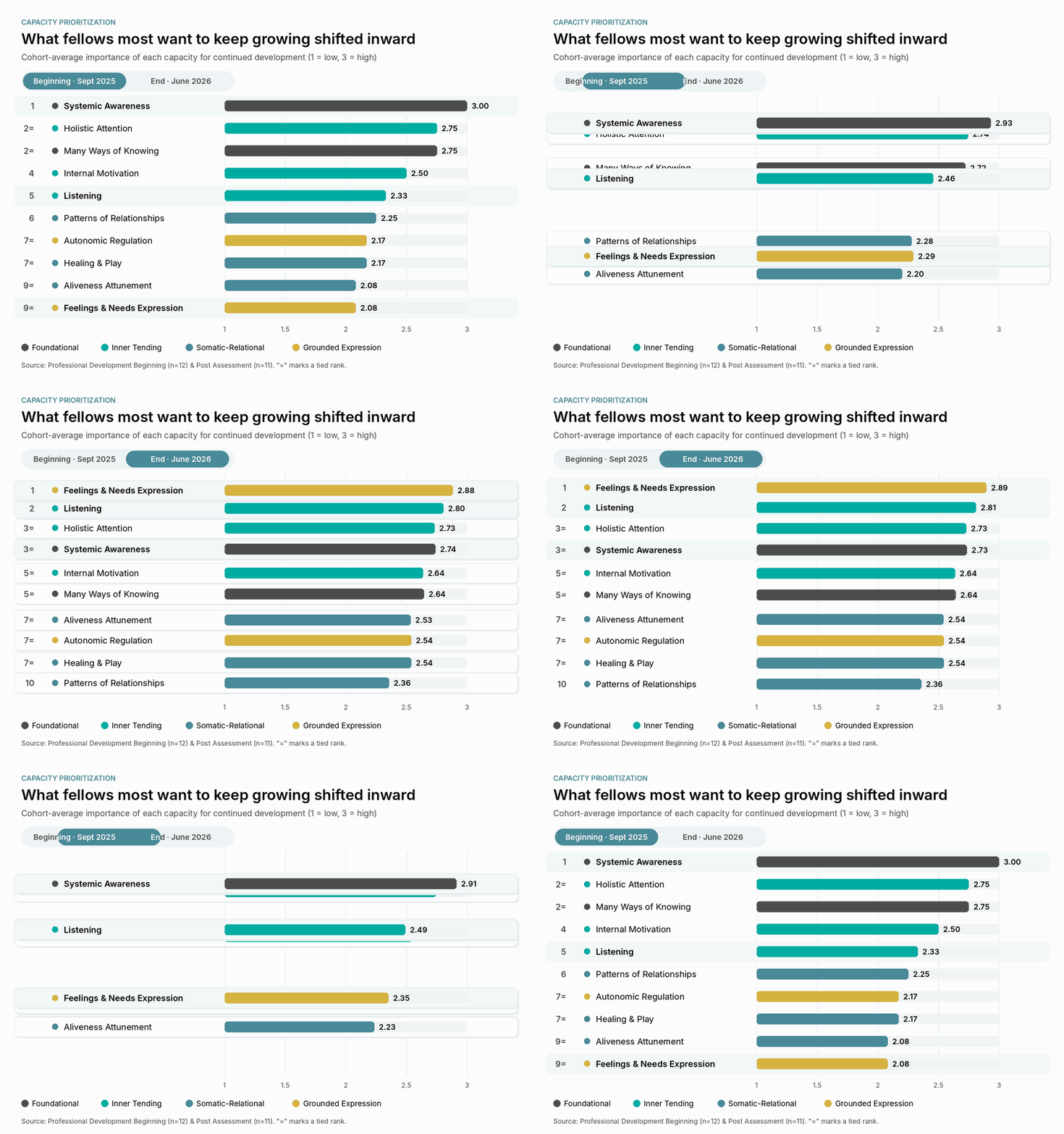
This is how groups effectively sense and respond as a collective. Underscoring its relevance, at the close of the fellowship Feelings & Needs Expression was rated the most important leadership capacity to continue cultivating.
+0.59
growth in Autonomic Regulation, leading the cohort’s most significant gains
Last → #1
Feelings & Needs Expression rose from tied-last to top priority for future growth
11 of 11
fellows agree inner capacity work enabled them to navigate complexity
EVIDENCE & FINDINGS
What changed
Autonomic Regulation and Feelings & Needs Expression, which together make up the Grounded Expression cluster, recorded the cohort’s most significant growth: Autonomic Regulation increased by +0.59 and Feelings & Needs Expression rose by +0.50. Leaders reported heightened attentiveness to unspoken energy, tension, and absent voices in high-stakes meetings, alongside a marked reduction in stress now that systemic change is understood as a distributed, collective effort.
The capacities fellows consider worthy of focus are different now. Feelings & Needs Expression moved from a tied-last priority at baseline to a solid first priority for continued growth after the fellowship. Listening, another attunement capacity, moved from the middle of the pack to second. The cohort’s sense of what matters most has moved from the outside in: from more cognitive, systems-facing capacities toward felt-sense, relational attunement.
Quantitative survey data is corroborated by universal agreement (11 of 11 fellows) that inner capacity development directly enabled them to navigate complexity and catalyze collaboration. We found that growth in the network is consistently paired with growth in self-understanding.

“Noticing what is happening within allows me to become more attuned to the energy and relationships in the room. I can sense larger patterns, opportunities, and tensions in the network and ecosystem.”
—LEDAMA MASIDZA, 2025-26 FELLOWREASONING
How it happened
By imparting somatic and relational practices and explicitly naming their role in network cultivation, we elevated relationality from “nice to have” to a fundamental for unlocking collective change agency in a network, and a key aspect of network health.
The program’s relational architecture provided permission and practical tools to pause, self-regulate, and listen differently. With a safe container to practice nervous system regulation and vulnerability, fellows were able to integrate these capacities directly into their facilitation and network orchestration.
Over time and with practice, fellows recognized that personal wellbeing and leadership are the same thing. This follows the “as within, so without” pattern we hypothesized: inner growth leads to outer impact.
MEANING FOR THE FUTURE
Why it lasts, and what it makes possible
Developing greater autonomic regulation and emotional clarity gives leaders a durable internal anchor when navigating ambiguity, power dynamics, and high-pressure environments. However, because daily operational demands and traditional organizational cultures constantly pull leaders back into reactive firefighting, maintaining this strategic agency requires ongoing effort. To sustain these mindsets long term, leaders will benefit from embedding regular personal reflection rhythms into their workweeks and cultivating organizational cultures that value self-regulation, strategic pause, and distributed leadership.
If maintained, this shift enables leaders to continuously guide their networks through complex systemic shocks without collapsing into panic or resorting to rigid, top-down control. Over time, this ripples outward to establish a new benchmark for collective leadership across the wider field, demonstrating that strategic agility and lasting impact are driven by emotional clarity, relational attunement, and shared agency rather than reactive urgency.
In their own words…
-
![]()
“I have a much deeper appreciation for the nuance involved in leading a network and the importance of self-regulation before trying to facilitate others.”
—Nicole Watson, Director of Networks and Membership at Social Value International
-
![]()
“I am more comfortable introducing play and intentionally leveraging the collective wisdom of participants in the room.”
—Khatuchi Khasandi, Network Coordinator, Kenya Innovation Ecosystem Funders Forum
-
![]()
“Rather than seeing tensions, power dynamics, or moments of uncertainty as problems to move past, I am learning to see them as information. I’m becoming more comfortable naming what is happening in a room, holding complexity, and inviting people into collective sensemaking instead of rushing toward solutions.”
—Ledama Masidza, Co-Founder, Local and Indigenous Food Systems Transformation (LIFT) Network


SIX INSIGHTS FROM YEAR ONE