
INSIGHT 6 OF 6 • PATHWAY: FIELD BUILDING
Moving from intuition to praxis
Confident leaders introduce more inclusive, collaborative practices that ripple through communities
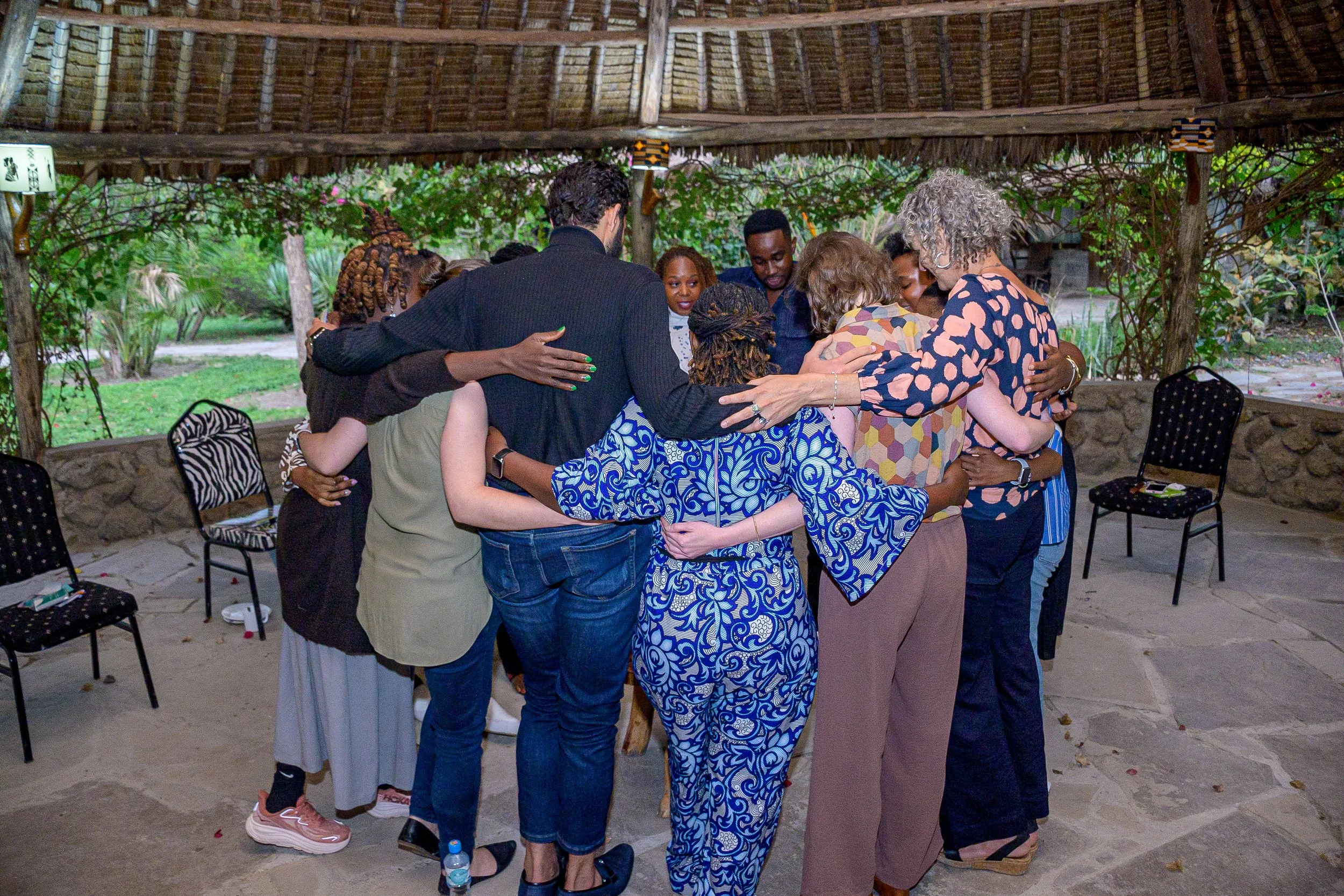
The fellowship provided language and structure to what had been instinct. Rooting practice in conceptual frameworks enabled fellows to explain to others why the work matters, and the practical tools made it easy to actively engage participants.
Strengthening capacities directly and indirectly through experiential learning gave fellows the confidence to adapt practices for their networks. Weaving theory, capacities, and capabilities into fully embodied practice enables network tools and mindsets to transfer across contexts and sector boundaries.
This understanding provides a blueprint for field building and deep scaling of the network practice necessary to coordinate within and across systems.
100%
of fellows credit co-designing and facilitating alongside Circle Generation with building their confidence
4 of 7
core practices, at minimum, implemented by every fellow outside the fellowship
90%
share practices with peers in the field (100% with colleagues)
EVIDENCE & FINDINGS
What changed
All fellows credit working alongside Circle Generation on co-designing and facilitating sessions with building their confidence (100% response rate). This points to the apprenticeship structure itself (watch, then co-design, then facilitate with support) as the confidence mechanism.
In the qualitative data, fellows repeatedly point to finding confidence on the other side of letting go of self-limiting beliefs and fears of making mistakes. They recognized that honoring everyone’s humanity, including their own, allowed them to embrace imperfection. Allowing their inner critics to soften liberated their attention to be directed outward, to stewardship.
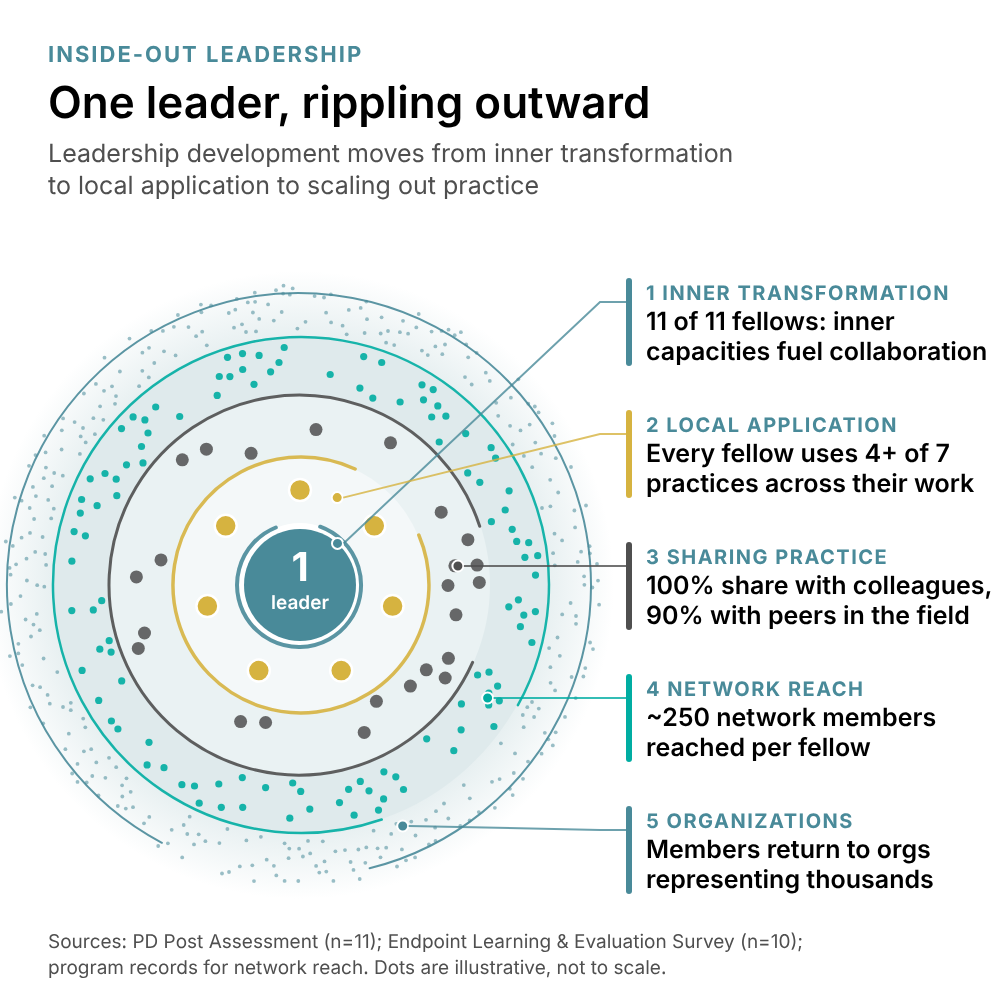
Alongside confidence building, we see fellows beginning to apply and share tools early in the fellowship, extension of practices increasing over time, and, at culmination, fellows actively aspiring to continue diffusing network practices. By the end of the fellowship, all fellows were sharing with colleagues and 90% were sharing with peers in the field. We tracked diffusion of seven core practices. Each practice was applied by a majority of fellows, and diffusion of some practices reached 90%. Individually, every fellow implemented at least 4 of 7 practices outside the fellowship, and the average fellow implemented 5 of 7, an average extension rate of 71%.
“I realized that the same network coordination tools I previously used for community-centered work can also be applied directly within regulatory spaces to create more collaborative and inclusive processes.”
—Elizabeth Howard, 2025-26 FELLOWREASONING
How it happened
We created a consistent arc running from learning, to living practice, to diffusing application. Vulnerability and imperfection play a functional role in the process. A context of humility and “not knowing” is essential for wayfinding in complexity. Fellows’ understanding that they don’t need to “always show up 100% perfect” to sustain the network creates room for experimentation.
Language and mentorship enable network tools and practices to successfully transfer across sector boundaries. When practitioners embody the mindset, understand the pattern language of practices, and have the language to explain their approach, they can confidently adapt practices to a diverse range of contexts. Thus, moving from intuitive organizing to network praxis creates ripple effects.
Inner tending practices sustain leaders’ systemic awareness. Cultures of care allow network participants to openly express their needs. Deep listening skills enable leaders to create conditions for the emergence of creative adaptations to shared challenges. Honoring participants’ agency naturally invites contributions to realize the network’s collective intent. As participants experience results firsthand, they are inspired to enter the same arc of learning, living practice, and diffusing application. It’s a virtuous cycle.
MEANING FOR THE FUTURE
Why it lasts, and what it makes possible
Confidence is contagious and motivates diffusion. Fellows connected the dots between growth in their self-understanding and growth in their networks, observing that as their self-awareness grew, so did member engagement in their networks. Resilient collaboration with members, combined with the language to articulate what to do and why, is what empowers practices to scale out from network participants to their home organizations and wider ecosystems.
With confidence built from inner transformation and strengthened through experiential learning, fellows’ extension of practices produces visible outcomes beyond polite reception. We heard from fellows that introducing inclusive network practices opens information flow among previously siloed stakeholders, enabling groups to gain greater perspective, increase situational awareness, see intelligent options for adaptive action, and effectively coordinate broad-scale strategies.
Having experienced what’s possible, fellows aspire to grow their networks, root foundational practices, scale out impact, and extend network principles to new audiences. In fellows’ commitments to ongoing stewardship, we see the seeds of substantive change described in our field-building impact pathway: a vibrant community of practitioners who normalize, integrate, and amplify network leadership.
In their own words…
-
![]()
“I have been invited to facilitate sessions more often, and I have had the opportunity to develop another network.”
—Ledama Masidza, Co-Founder, Local and Indigenous Food Systems Transformation (LIFT) Network
-
![]()
“Looking ahead: bringing partners in to build a network of active, engaged members that embodies the network practices and has a real intention for system change.”
—Hellen Nakyeyune, Senior Programme Associate, Capital Solutions Limited
-
![]()
“One of my biggest revelations from the fellowship was that the lessons and practices learned go far beyond formal network spaces.”
—Ajoke Adeola, Founder, REEL Foundation
-
![]()
“Looking ahead: co-creating conversations, research, and spaces that help more people understand themselves as part of interconnected networks working toward collective flourishing.”
—Nate Harding, Head of Global Engagement, Government Council for Social Innovation
-
![]()
“I learned the language of network leaders and the importance of making network leadership work more visible. By clearly articulating shared visions, operational models, and leadership practices, I have been able to attract greater support from my network and focus more strategically on leadership work.”
—Khatuchi Khasandi, Network Coordinator, Kenya Innovation Ecosystem Funders Forum



SIX INSIGHTS FROM YEAR ONE