
INSIGHT 4 OF 6 • PATHWAY: ORGANIZATIONAL
Mentoring supports mentoring
Bopa DiPeo’s co-design process turns leaders into facilitators who trust themselves and teach others
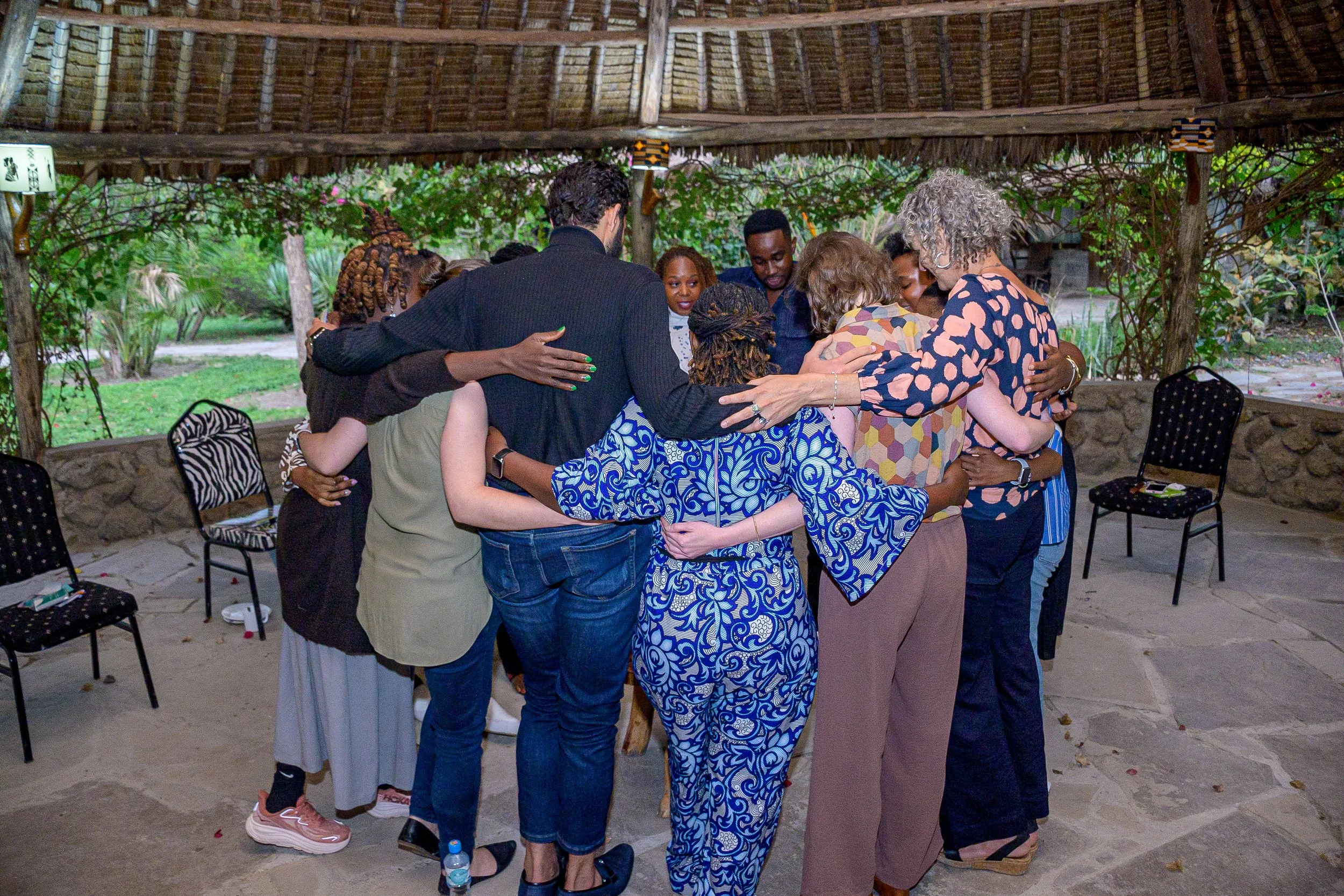
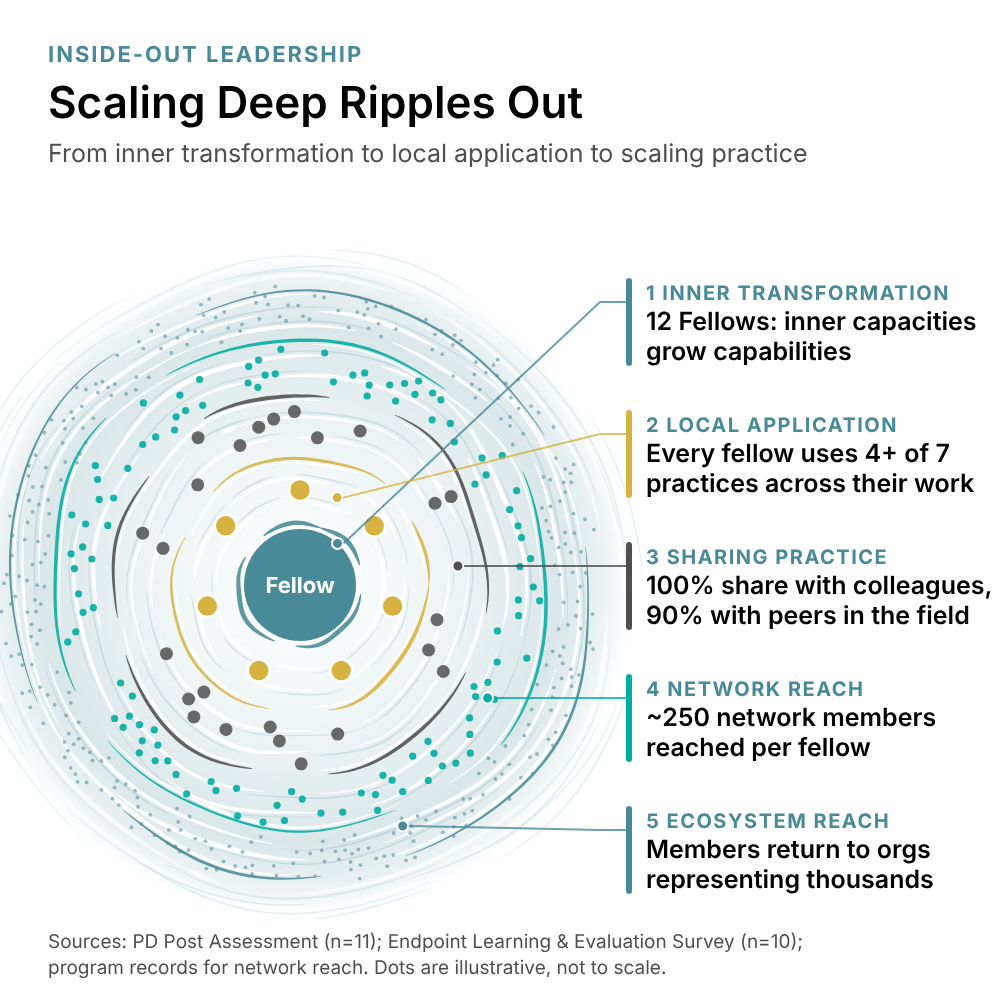
All fellows are applying what they are learning with their networks and sharing practices with colleagues. Fellows show a definitive shift to taking a relational approach in engaging members.
They organize sessions and frame communications with participants’ perspectives at the center, and they are comfortable sharing facilitation techniques with others.
They describe network tools and frameworks landing and leading to visible outcomes in stakeholder engagement, network support, ecosystem building, and mentoring.
100%
of fellows use the practices with their network or team
5 of 7
key practices applied by the average fellow; two fellows applied all seven
100%
shared capacity-building practices, like listening and autonomic regulation, with others
EVIDENCE & FINDINGS
What changed
As fellows gained confidence in listening holistically, seeing patterns, and interacting with their networks, we saw application increase across the board. The circumstances of applied learning, the number of practices applied, and the variety of people introduced to practices all consistently increased across the cohort. Application of systems awareness practices and participant engagement activities grew the most over time.
We measured how many fellows applied each of 7 key practices. Every practice was applied by at least 60% of fellows. On average, each fellow applied 5 of the 7, and two fellows applied all seven. 90% of fellows put engagement activities and consent decision making into practice. At least 60% of fellows are applying learning in 7 functional areas of their work, such as communications, board meetings, and difficult conversations. 100% of fellows confirm they use practices when collaborating with their network or team.
100% of fellows are sharing practices with colleagues; 90% with peers. Notably, 100% of fellows shared practices that develop inner capacities, such as many ways of knowing, listening, and autonomic regulation. Fellows describe tools and frameworks landing and making a difference with their teams, network members, and boards. At culmination, fellows spoke to having both the confidence to implement practices and the desire to extend capabilities to others.

“I learned practical ways to break silos. Creating connections between stakeholders who had historically worked separately, I have seen information begin to flow more openly. What began with 10 organizations stretching from the north to the south coast of Kenya started growing into a connected ecosystem.”
—LEDAMA MASIDZA, 2025-26 FELLOWREASONING
How it happened
Bopa DiPeo was designed to create ripple effects. We continuously emphasized the importance of translating learning into action, starting with the expectation that fellows align their learning arc with their network’s activities over the year. At the opening convening, we actively modeled practices that allowed fellows to experience themselves as participants before stepping into facilitation.
Our three-step mentorship approach accompanied fellows through a detailed design process and prepared them to facilitate participatory sessions. Fellows were lovingly guided to think concretely about how message framing, content, and interactions would be experienced by participants in real time. Guides focused on how presence, pacing, and sequencing of activities create conditions for the emergence of desired outcomes. We actively shaped fellows’ orientation to engagement as a collective experience and minimized tendencies to control or constrain participant interaction.
MEANING FOR THE FUTURE
Why it lasts, and what it makes possible
We deliberately designed for transferability by making the fellowship’s practice structures as close to the “real work” as possible. Ensuring practice opportunities were relevant to fellows’ everyday work was essential to achieving two of our key objectives: all fellows feel confident leading meetings and comfortable sharing design and facilitation techniques with others.
We are acutely aware of the importance of reach. Recognizing that complexity leadership is acquired through situated practice over time in a small, cohesive group, we strategically counterbalanced the seemingly small cohort by explicitly selecting leaders well positioned to mentor others and champion practices in their networks. The 12 fellows directly touch about 3,000 members, and these members work in organizations with more than 300,000 people combined.
Over time, we’ll be able to see the extent to which network principles diffuse from network members to organizations and become ripple effects in the larger field of network practice. Fellows have both experienced the relevance of relational work and learned explicitly how to do it, so they can carry it into the wider field. We believe that investing in network leaders who can themselves create network effects through modeling, mentoring, and transferability is the most cost-effective, strategic approach to scaling complexity leadership.
In their own words…
-
![]()
“Participant engagement has changed dramatically. Using tools (new vocabulary, play, autonomics, care culture) in all stakeholder engagement sessions has yielded better experience and feedback.”
—Elizabeth Howard, Founder, Women in African Investments Group
-
![]()
“I apply network leadership principles in mentoring emerging community leaders, helping them navigate challenges, connect with broader communities, and recognize that many struggles they face are shared experiences among network leaders.”
—Khatuchi Khasandi, Network Coordinator, Kenya Innovation Ecosystem Funders Forum
-
![]()
“I am glad to share that all these are taking root. My recent conference used weaving in planning, systems awareness in theming, and strategic engagement in execution.”
—Evans Okinyi, CEO, East Africa Philanthropy Network
-
![]()
“I’m designing spaces that invite participation instead of extraction: asking better questions, slowing conversations down, and making room for quieter voices to shape direction.”
—Hellen Nakyeyune, Senior Programme Associate, Capital Solutions Limited
-
![]()
“I used some of the learnings from the Nairobi Convening to design a convening experience for my local church. The feedback from that event has been very positive.”
—Ajoke Adeola, Founder, REEL Foundation



SIX INSIGHTS FROM YEAR ONE