
Building Trauma-Informed Networks: Principles from Practice
By Nonzwakazi (Nzwaki) Adonisi
Recently and across several projects within the violence-prevention community, the need for trauma-informed practices has felt especially present. Building a healthy and effective violence-prevention ecosystem is demanding not only because of the familiar challenges of network and movement building—fragmented coordination, siloed efforts, and competition for scarce resources—but also because the work itself is often deeply distressing.

Practitioners frequently carry lived experience as survivors into these spaces; topics can be difficult to discuss openly; and language often requires reframing to engage funders and broader audiences who may find the subject matter triggering. Over time, the weight of these combined burdens contributes to relational strain, burnout, and high turnover.
While this toll is explicit in networks focused on displacement or conflict, it also appears more subtly in fields that may seem “trauma-free,” such as food systems, inclusive finance, or climate action.
Core network leadership practices—nurturing connection, building trust, collaborating openly, and sharing resources—already lay the foundation for trauma-informed environments.
This article offers a set of practices as a living framework for leaders stewarding networks where trauma may be present—whether named and visible or subtle and unspoken. These practices invite ongoing adaptation, reflection, and a commitment to letting relationships lead.
What Do We Mean by “Trauma-Informed”?
A trauma-informed approach recognises how distress affects relationships, learning, growth, and participation in group settings. It centres inclusion and dignity, respects varied experiences, and designs conditions that enable trusting, meaningful, and generative collaboration.
The working definition of trauma is distress that overwhelms our capacity to cope.¹ Traumas can be “big” (e.g., life-threatening events) or “small” (e.g., persistent high anxiety over deadlines). With repetition and time, small traumas can accumulate into larger impacts. Trauma occurs across the socio-ecological spectrum, including:
Household: substance use, separation/divorce, mental health challenges, domestic violence, incarceration
Community: discrimination, under-resourced schools, poverty, inadequate housing, poor air/water quality, food insecurity, unemployment
Environmental: pandemics, drought, floods, extreme heat, sea-level rise
How Trauma Can Show Up in Network Settings
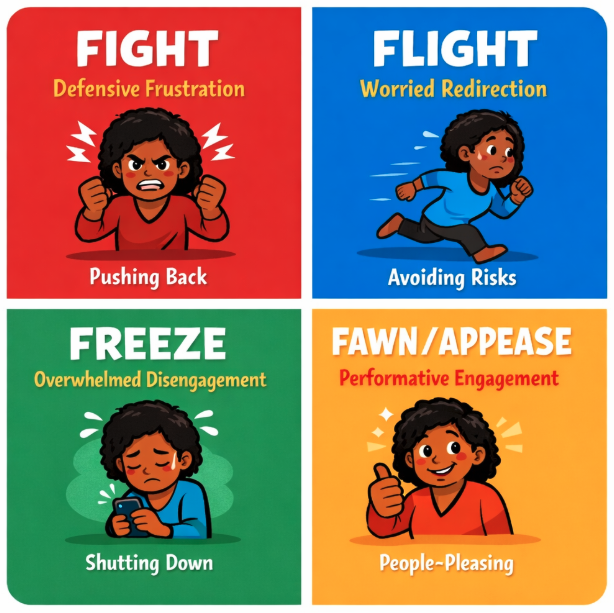
Many of us know the “fight or flight” response. In our networks, trauma responses in groups often fall into four broad patterns. Recognising these patterns in moments of navigating tensions (which are inevitable) as a network leader, will invite a more trauma-appropriate response when exploring the causes of tension and co-creating a path forward:
Fight — Defensive frustration
Example: A member resists recommendations drafted without their participation. This person may be labelled as “difficult,” yet it often signals an attempt to regain agency in the ideation process.
Flight — Worried redirection
Example: A member argues to narrow strategic priorities if they believe the network lacks the capacity or resources to take on too many priorities. Rather than what may be perceived as “low ambition,” they may be mitigating the anxiety and risk of strategic derailment or failure.
Freeze — Overwhelmed disengagement
Example: Faced with an over-full meeting agenda, a member may anticipate failure to cover all the items with the required care and withdraws from the meeting or workshop to avoid the feeling of anxiety and loss of control—this may look like taking frequent breaks, skipping sessions, or focusing on their mobile phone.
Fawn/Appease — Performative engagement
Example: A member agrees publicly with an approach, to appease a convenor or dominant group, shaped by prior experiences or power dynamics, while privately feeling misaligned.
These responses are frequently triggered by a feeling of reduced agency, loss of control, or overwhelm.
Six Principles for Trauma-Informed Network Practice
From on-the-ground experience, several approaches have proven powerful:
Self-awareness and support
Bill O’Brien observed, “The success of an intervention depends on the interior condition of the intervenor.” Trauma-informed convening begins with the emotional and psychological landscape of the convenor—coordinator, facilitator, or host organisation. Understand the personal stories, biases, power, and triggers you bring (perhaps instances in your life where there has been violence), and prepare practical support for when they arise (e.g., supervision, peer reflection, embodied grounding, counselling).
Choice and empowerment
Design for agency. Offer opt-in/opt-out pathways and self-direction wherever possible: choose breakout rooms, select break times, co-shape content trajectories, and vary levels of participation (e.g., offering facilitation roles). Small, frequent choices preserve a meaningful sense of control.
Co-creation across the arc
Partner before, during, and after convenings. Invite diverse perspectives in setting the agenda, content, flow, and delivery—and make revision a collective practice.
Transparency and trusted disclosure
Psychological safety grows with clear, generous communication. Share planning assumptions, agendas, constraints, and decision rationales to cultivate trust and reduce uncertainty.
Normalise self-care and recovery
Sustainably hold trauma-informed spaces by contractually embedding care: name support approaches for triggering moments (“if you feel overwhelmed, we agree to do X”), include embodied practices (breathwork, movement, play), and create post-convening rituals (time in nature, grounding meditations, counselling). Regular group debriefs with psychosocial specialists (monthly or quarterly) can be highly effective.
Build strong referral pathways
Maintain an up-to-date list of psychosocial and mental health services to refer members who are triggered during convenings or for those who request additional support.
Case Example: A Youth Fellowship Centring Agency and Care
In a recent youth fellowship, we applied trauma-informed network leadership by centering agency, dignity, and intergenerational learning while intentionally moving away from hierarchy and “isolated hero” models. We cultivated a trust-based, abundance-oriented network by openly sharing resources, investing in collective wellbeing through coaching and embodied practices, and treating power as something that grows when shared. By the fellowship’s end, fellows independently created a “network of networks” to sustain collaboration—designing the model, fundraising, and coordinating without facilitator direction—demonstrating how trauma-informed, care-centred design can generate durable, self-organising networks rooted in trust, emergence, and adaptive action.

One image that stays with me of this fellowship is the lotus—rooted in sediment and rising through murky water to bloom, untouched and radiant. In ecosystems marked by fragmentation, trauma, and misused power, the lotus reminds us that beauty can rise from adversity. If we as network leaders co-create the conditions for the lotus—even in the harshest environments—there is real reason to hope.
If you are stewarding a network where trauma may be present—explicitly or beneath the surface—consider these practices as a living framework. Adapt them to context, revisit them often, and centre the wisdom of the network’s relationships.
1 Dr Dan Siegel, National Institute for the Clinical Application of Behavioral Medicine, 2019

Nonzwakazi (Nzwaki) Adonisi
Facilitator, network coordinator, consultant and chartered accountant with 15 years of experience working within the impact, systems-change, development and finance sectors. Has designed and led several ecosystem-building projects, and managed multi-country teams towards impact-driven collaboration. Her work ethic, value system, empathy and curiosity have enabled her to bring unique perspectives, passion, and positive change to a range of organisations and projects across Africa.